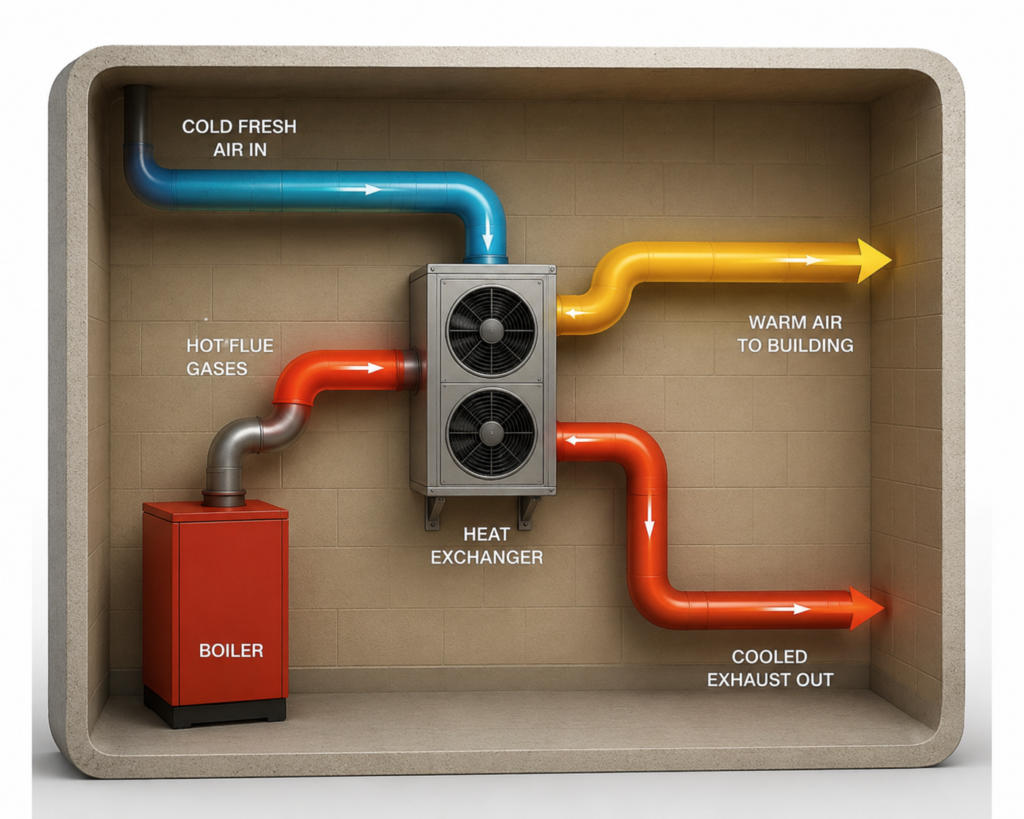
Heating accounts for a significant proportion of the UK’s carbon emissions, with more than 23 million homes relying on gas-fired boilers and 92% of non-electrical energy consumption in non-domestic buildings attributed to gas boilers.
Highland Heat Harvesters (HHH) has developed an innovative flue gas heat recovery device that captures waste heat from boiler exhaust gases and returns it to the building, with lab testing showing the potential to reduce gas consumption by up to 20%.
The Data Lab partnered with Highland Heat Harvesters and Robert Gordon University (RGU) to explore AI and machine learning techniques to optimise the device’s design, helping bring the technology to market more quickly.
The Challenge
The basic concept and design of the flue gas heat recovery solution had been supported by the wider Scottish innovation ecosystem such as Interface. The challenge HHH faced was how to bring this technology to market more quickly.
Designing and refining each version of the heat recovery device requires engineers to understand how hot gases flow through the system. To do this, HHH relies on Computational Fluid Dynamics (CFD) – a highly accurate but computationally intensive modelling technique that simulates the behaviour of flowing fluids. While there are ways to reduce simulation times, these often compromise the accuracy of the results.
As the business develops bespoke designs for different applications, it needed a faster way to optimise products without sacrificing the accuracy required to support well-informed engineering decisions and reduce reliance on costly physical prototypes.
The Solution
Through The Data Lab’s Pump-Prime Funding, Highland Heat Harvesters collaborated with researchers from RGU to investigate whether AI could help overcome this challenge.
The project combined traditional Computational Fluid Dynamics modelling with AI and machine learning techniques to create a hybrid modelling approach. Rather than replacing CFD, a surrogate model was developed and used to accelerate the design optimisation process by helping predict gas flow behaviour more efficiently, reducing the time required to assess different design options while maintaining a high level of confidence in the results.
This approach has enabled Highland Heat Harvesters to evaluate application-specific designs more quickly, supporting faster product development to move new designs into manufacturing and deployment.
Outcomes
Highland Heat Harvesters and RGU now have a digital toolset containing data-driven design and performance charts. The results of the collaboration demonstrated that the technology is viable under real-world conditions and enabled HHH to engage specialists in heat-exchange design.
HHH continue their drive to market, and with The Data Lab signposting, they have secured additional support through the Scottish Enterprise Green Heat Innovation Support Programme and the Smart Things Accelerator Centre.
HHH expect to continue growing, adding staff and building a Scottish supply chain for their products. They have already partnered with Hawick-based Turnbull & Scott to manufacture the heat exchangers and Glenrothes-based JRF Chimneys for installation. The Scottish Centre for Net Zero High-Density Buildings team will provide the necessary independent study of the device efficacy, which will help HHH achieve full UKCA and CE certification.
The research at RGU helped them enhance their reputation for expertise in advanced simulation techniques and deepen their understanding of machine learning and AI applied to CFD datasets. This has subsequently enabled further academic research beyond the project, resulting in two high-impact journal publications, and the project’s results are expected to be published in a reputed international journal by late 2026. The project directly supported and secured two research posts, which are continuing to have an impact post-project. Furthermore, the research project led to a pathway for a potential impact case study for REF 2028.
Amid growing demand for retrofit solutions that enhance energy efficiency and reduce emissions, HHH’s novel technology will help advance national Net Zero targets, potentially reducing the UK carbon footprint by up to 10%. This would be a significant step towards reducing reliance on fossil fuels, with a reduction in carbon emissions from the boilers, leading to less air pollution, improving urban air quality and, in turn, positively impacting public health and wellbeing.
Next steps
Highland Heat Harvesters is now working with several Scottish councils and other public-sector organisations to install the technology in real-world settings and to gather operational performance data. This pilot phase will help validate the simulation work, build confidence in the technology, and support wider commercial adoption ahead of the planned launch in mid-2027.
Looking to the future, they plan to move their product across the UK, followed by Europe and North America, targeting colder regions with ageing building infrastructure.
“As an early-stage technology company, access to the expertise within Robert Gordon University and The Data Lab has been a game-changer. The collaboration helped us develop capabilities that would have taken much longer to build independently, accelerating both product development and commercial readiness.
Brendan O’Toole, Chief Executive Officer, Highland Heat Harvesters
“Their support has helped us enhance our technology, strengthen our data-driven insights, and further our mission of delivering meaningful carbon and energy savings for customers.”