Marian is The Data Lab Academy Programme Manager at The Data Lab and leads the Innovation Challenge each year as part of our Scottish Funding Council-funded Masters Scholarship Programme. In this blog, she reflects on Innovation Challenge 2026 and the talent, creativity and resilience demonstrated by this year’s student cohort.
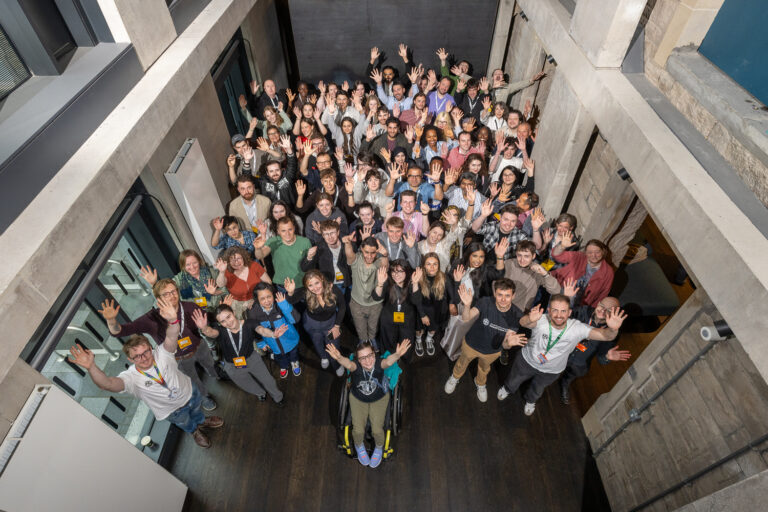
The Data Lab Skills team and our fabulous masters students had a blast at this year’s Innovation Challenge, 2nd-4th June, hosted at the picturesque Edinburgh Futures Institute, University of Edinburgh.
What was this all about? Well, through our Scottish Funding Council-funded Masters Scholarship Programme, The Data Lab offers full-fee scholarships to students studying data and AI (and related subjects) across 14 universities in Scotland. Alongside their academic studies, students join our professional development programme, which offers a unique blend of learning and events curated to increase confidence and prepare them for the next step in their professional journey.
The Innovation Challenge is the programme’s final standout event. Over three days, students work in intra-university teams, applying their academic and professional learnings to real-world challenges proposed by Scottish organisations. It’s my favourite part of the masters calendar, where I get to know the students, find out about their individual academic and personal journeys and hear about their plans for the future. And what a diverse, resilient and talented group they turned out to be!
With generous support from Nicola Cooper and Sarah Burne James (IBM), Mairi Black (Clackmannanshire Council) and Michael Kermack, Joshua Spencer-Bowles and Sean Murchie (Scottish Government), and guided by our delivery partners at The Edinburgh Future’s Institute, we presented students with a set of real and very pressing challenges for Scotland. Our theme was “Exploring Infrastructures for Scotland’s AI Futures”. The three challenges represent issues of current and societal importance around:
- Future‑proofing Scotland’s planning processes: How can Clackmannanshire Council harness data and AI to build a sustainable, evidence-based Local Development Plan that engages communities, identifies data gaps, and remains feasible with limited resources?
- Ensuring an inclusive transition to an AI‑enabled workforce: How can data and AI identify who is being left behind in the transition to an AI-enabled workforce? What interventions, tools, and learning infrastructures are needed to ensure no community in Scotland is excluded from upcoming opportunities?
- Ensuring open and accessible discussion about the potential and risks of Data Centres in Scotland: What methods can we use to assess, model, and communicate the impact of hosting AI data centres in Scotland? What data sources can help inform decisions regarding optimal locations and construction approaches to maximise benefits and minimise harm for local communities, the economy, and the environment?
The agenda included workshops on Design and Futures Thinking, Implicit Bias, as well as guided studio and coaching sessions. Students grappled with the challenge topics and completed the first difficult task – selecting a challenge and exploring potential approaches using suggested deliberation points. Oh, and choosing a team name with an eye on the EFI prize for best team name (FYI, the winners were ‘Cache me if you can’).
Momentum built quickly as teams formed strong networks, a key element of the masters programme. Business mentors from The Data Lab’s partner network and our own alumni supported teams as they refined their concepts. This is an important part of the event – giving students practice in presenting early work-in-progress ideas to data and AI professionals and receiving feedback on their proposed approach. Much of the feedback focused on ambition and time constraints, hardly surprising given the big questions and the limited time available.
Of course, no Innovation Challenge is complete without the social side: coffee by the bucket, pizza on day one, a summer buffet at The Bayes Centre on day two, and plenty of opportunities to explore Edinburgh — from sunsets at Arthur’s Seat to Teviot’s bars and quiet downtime at Pollock Halls.
The grand finale of the Innovation Challenge is the delivery of a seven-minute lightning talk: 20 slides, 20 seconds each. Not for the faint-hearted, but a brilliant and disciplined way for teams to describe their approach, walk the audience through their data-driven response, and showcase the relevance of their proposition to the overall theme and chosen challenge. The students delivered their talks to the judging panels in challenge groups. It was nerve-wracking – but they did it, and did it well!
Each member of the three winning teams will receive tickets for DataFest 2027 and the opportunity to present to senior stakeholders at the challenge organisations.
And the winners are:
- IBM: Project Hail Matrix
- Clackmannanshire Council: Clackheads
- Scottish Government: Granite, Bridge & Tay
Although prizes are always welcome, the core objective of our Innovation Challenge 2026 was to give our cohort confidence in their ability to apply their academic learning in a business context, build their networks, and set them up for the final chapter of their masters programme. The students more than met that objective – and so I am happy to say they are all winners to me!
Before we wrap up, I’d like to recognise the many people and organisations who helped make this year’s Challenge possible. Our challenge owners generously gave their time, expertise and enthusiasm to shape projects rooted in issues of real national importance:
- Mairi Black — Principal Planner, Clackmannanshire Council
- Nicola Cooper — Supply Chain Executive, IBM
- Sara Burne James — Solution Architect, IBM
- Michael Kermack — Senior Policy Official, Green Data Centres, Scottish Government
- Sean Murchie and Joshua Spencer‑Bowles — Economists, OCEA
We were also delighted to welcome partners and mentors from IBM, Barclays, the Scottish Government, Research Data Scotland, Talan, Skyscanner, and our alumni community, whose insights and encouragement helped students refine their ideas and build confidence in their approach.
A special mention must also go to our delivery partners at the Edinburgh Futures Institute, whose support and expertise helped shape the experience from start to finish, and to my colleagues Dan Yan and Max Baczynski for all of the hard work behind the scenes that kept everything running smoothly.
A great event, a great set of challenges, and an even greater group of students. We can’t wait to see what they’ll do next – and we’re already looking ahead to Innovation Challenge 2027.